
An Internship at NatureHelm Merging Code with Ecological Urgency
Hi! I’m I Komang Sena Aji Buwana and you can call me Sena. Almost one year ago I traded Bali’s beaches for Canberra’s crisp mornings to pursue a Master of Computing at the Australian National University. Now, as a Software Engineer intern at NatureHelm, I’m merging the discipline of banking and fintech engineering with the urgency of biodiversity intelligence, building tools that help businesses turn ecological complexity into decisions that actually protect ecosystems. Shifting from ledgers and transactions to geospatial data and nature disclosure felt like the natural next chapter with same rigour but bigger stakes.
What was it specifically about NatureHelm’s mission that compelled you to choose an internship here?
NatureHelm stood out because it transforms messy ecological and geospatial data into clear, decision‑ready intelligence that helps companies act nature‑positively, not just report it. That mission matches a personal goal to build software that reduces environmental risk and unlocks opportunities, turning technical skills into outcomes that matter for people and places.
The momentum behind nature disclosures makes this even more exciting: location‑specific, comparable data is quickly becoming essential for credible reporting and real operational decisions. NatureHelm’s focus on high‑integrity datasets and practical workflows positions it to help organisations move from intent to implementation.
The engineering challenge was a bonus. The stack spans React with TanStack on the front end, NestJS and PostgreSQL on the back end, and serious geospatial muscle with Mapbox and PostGIS, perfect for turning complex maps and polygons into reliable, user‑friendly features. Looking ahead, the platform’s potential around green finance enablement and AI‑assisted environmental analytics is a natural bridge between previous fintech experience and mission‑driven tech.
What does a typical day look like for you as an intern at NatureHelm?
Most mornings start with coffee and a quick plan: which flow to sketch, which bug to hunt, and which edge case to try and break before a user ever sees it. I split my time between UI/UX analysis, full‑stack development, and geospatial data wrangling. One hour I’m tuning forms in React with schema‑driven validation, the next I’m wiring a NestJS endpoint and making sure a polygon behaves in PostGIS. After each slice of work, I open a merge request for review; the feedback loop is fast, and it’s where most of the learning happens.
Weekly rhythms keep the team in sync. In standups, I share what shipped, what’s next, and any blockers; it’s short, focused, and keeps momentum. WING sessions (short for Wins, Insights, Needs, Gratitude) are my favourite: a genuine space to celebrate progress, swap lessons, and ask for help without the ceremony. A highlight was a week working together in the office, capped by a Mount Painter volunteering day protecting native plants, and yes, meeting a few very confident kangaroos.
Can you describe the main project you’ve been working on?
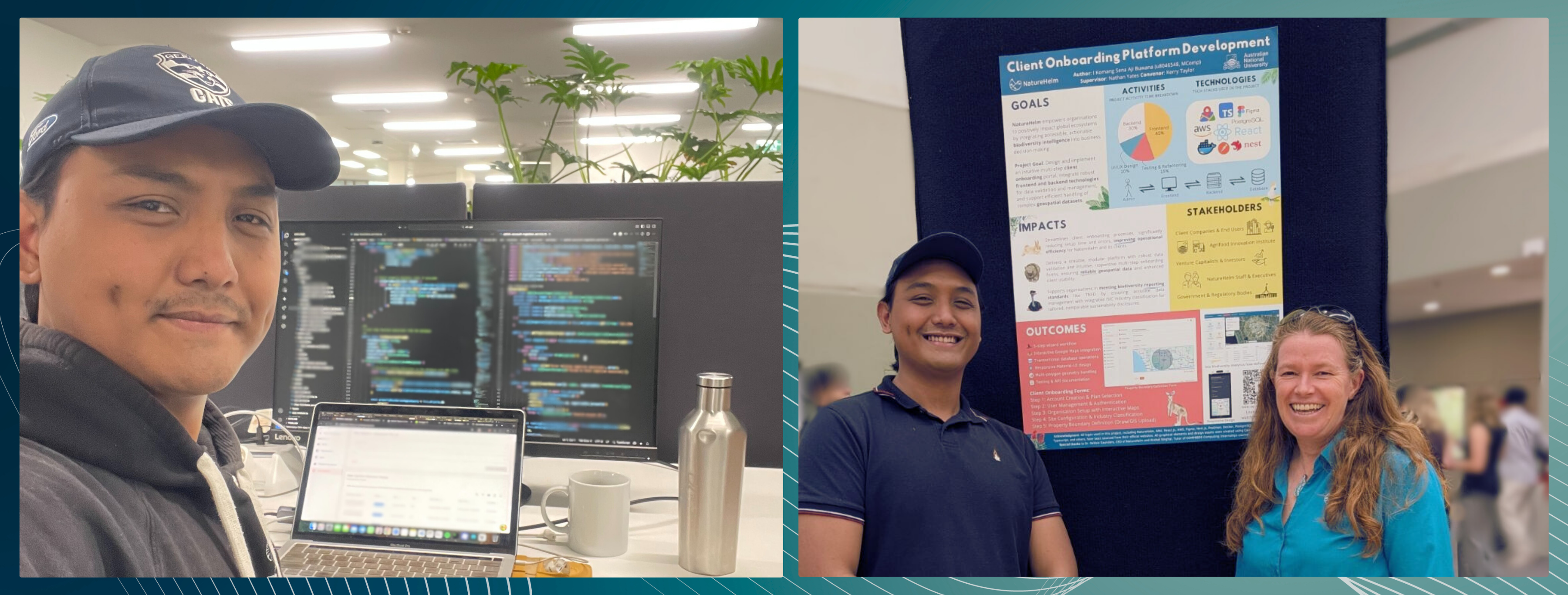
I’m building a five‑step client onboarding wizard that brings accounts, users, organisations, sites, and property boundaries into one clear, guided flow. It fixes two big pain points: slow, manual onboarding and geospatial mistakes that used to creep in when data was entered across multiple tools.
My role spans end‑to‑end delivery. I designed the stepper UX, set up validated forms, and built map workflows so people can add locations and polygons the way that suits them. On the backend, I wrapped every insert in a single transaction so if anything fails, nothing breaks or gets orphaned.
What are your next steps after the internship?
This internship taught me how to take a product from zero to deploy, designing the UX, validating data front to back, and shipping a reliable flow that handles complex geospatial inputs. I’m leaving with practical strengths in schema‑first forms, transactional backends, and mapping workflows that make messy real‑world data usable.
Next, I’m targeting full‑stack roles with a strong data focus, where I can cut manual processes and keep data quality airtight. I’m also keen to explore data science and engineering opportunities, building on hands‑on experience with ingestion and transformation to power trustworthy analytics.
What is one piece of advice you would give to a student?
Be the teammate people trust: share your progress early, surface your bugs even earlier, and turn feedback into momentum. Confidence isn’t pretending to have all the answers, it’s about showing your work, asking for help, and helping others ship better work too. Remember, products are team sports; transparency turns mistakes into shared learning and shared learning into real velocity.